
Counter-drone detection layers: radar, RF, optical and acoustic
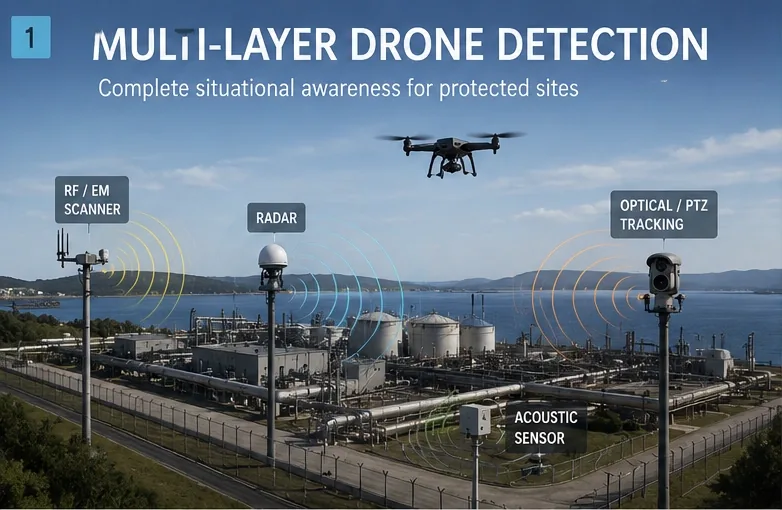
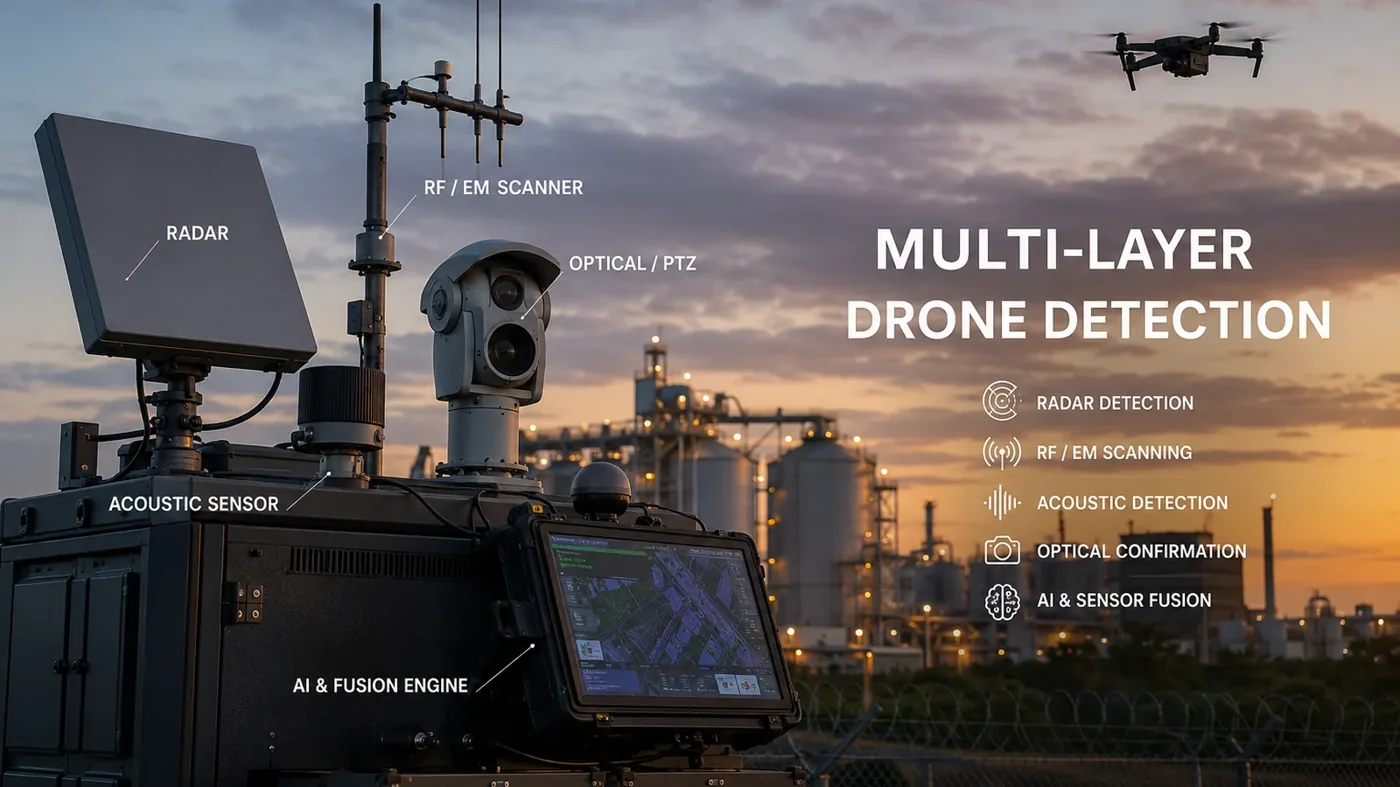
No single sensor sees every drone. A reliable counter-UAS detection architecture combines radar, RF/EM scanning, optical PTZ confirmation and acoustic sensors into one fused operational picture for the protected site.
Key takeaways
Multi-layer drone detection in brief.
Reliable counter-UAS detection combines several sensor technologies instead of relying on a single detector — each layer covers the others' blind spots and the platform fuses them into one operator view.
What is multi-layer drone detection?
Definition.
Multi-layer drone detection is a counter-UAS approach that combines radar, RF/EM scanning, optical PTZ confirmation and acoustic sensors into one fused operational picture for a protected site. The goal is not only to detect a drone, but to understand where it is, how it moves, which sensors detected it, how confident the system is, what the operator should check next and what evidence should be recorded.
Why one sensor is not enough
Every detection technology has a blind spot.
A radar may detect a moving object but require confirmation to distinguish a drone from clutter or birds. RF detection may identify drone communication signals, but is limited when a drone operates autonomously or stays radio-silent. Optical PTZ cameras confirm a target visually, but depend on line of sight, weather and lighting. Acoustic sensors add passive local awareness, but background noise and wind reduce range. Each technology has a specific role — a protected site needs a layered architecture where each sensor compensates for the limits of the others. Short answer for operators: a single detector creates isolated alerts; a multi-layer system creates an operational picture.
Radar drone detection
The wide-area backbone.
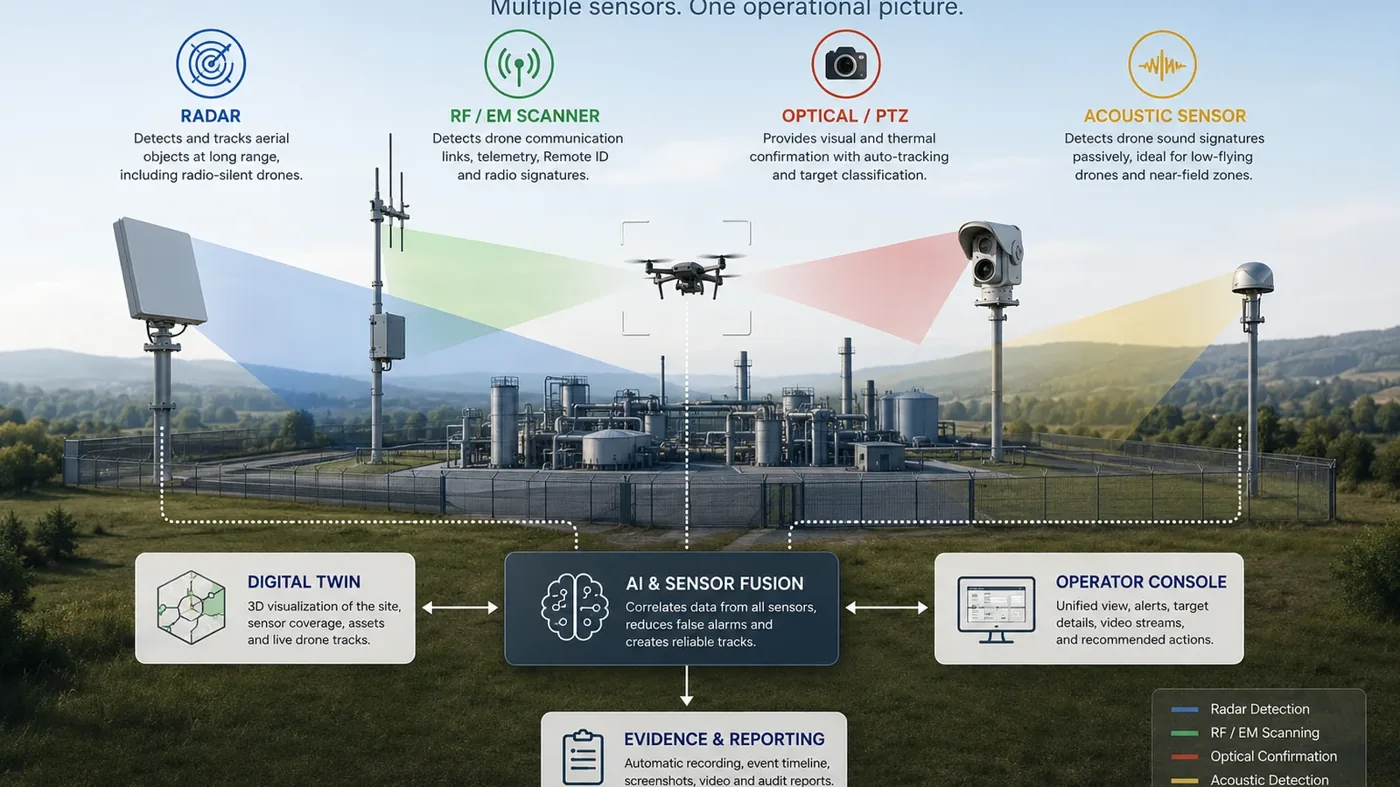
Radar is often the wide-area backbone of a counter-UAS system. It monitors the protected airspace, detects moving aerial objects, creates tracks and estimates direction and speed — and is especially important when a drone is not transmitting radio signals. It is useful for early warning, range and bearing, track creation and cueing optical PTZ cameras onto a target. Its limits include small radar cross-section, low-altitude clutter, terrain, buildings and complex industrial environments. In DroneDefender, radar is not an isolated device: radar tracks become part of a unified architecture fused with RF/EM, PTZ confirmation, acoustic alerts and Digital Twin visualization.
RF / EM drone detection
Detect the link, not just the aircraft.
RF/EM scanning passively listens for drone-related radio activity. Many drones communicate with a controller, transmit telemetry or video, or broadcast identification data. RF/EM detection can therefore support signal detection, classification, protocol recognition, Remote ID awareness and, in some configurations, operator direction finding. The limitation is clear: a fully autonomous or radio-silent drone may leave little or no RF signal, and industrial or urban areas carry heavy radio noise. RF/EM is most valuable when fused with radar, optical and acoustic layers.
Optical PTZ and thermal confirmation
Turn a track into a confirmed threat.
Detection is not the same as confirmation — a security operator usually needs to see what the system detected. Optical PTZ and thermal cameras turn a track into a confirmed object. Cued by radar, RF/EM or acoustic alerts, the operator receives a directed view of the potential target instead of manually searching the sky, supporting visual verification, classification, operator confidence, tracking and evidence recording. Weather, fog, low light, glare and line-of-sight restrictions can reduce optical performance, which is why PTZ is best used as a confirmation and evidence layer connected to the rest of the system.
Acoustic drone detection
The near-field backstop.
Acoustic detection is a passive layer based on the sound signatures of drone motors, propellers and flight behaviour. Microphone arrays or distributed acoustic nodes help detect and estimate the direction of low-flying or close-range drones. Acoustic detection adds near-field awareness, local perimeter monitoring and passive detection around protected points. It is not a replacement for radar, RF or optical — its value is to add another layer, especially where low-altitude approaches or blind spots matter.
Sensor comparison
How the layers complement each other.
| Sensor layer | Best for | Limitations | Role in DroneDefender |
|---|---|---|---|
| Radar | Moving aerial targets, radio-silent drones, wide-area monitoring | Clutter, terrain, object size and environment | Creates tracks and supports early warning |
| RF / EM scanner | Control links, telemetry, signatures and Remote ID | Limited against fully autonomous or radio-silent drones | Detects signals and supports classification |
| Optical PTZ / thermal | Visual confirmation, tracking, evidence and operator confidence | Weather, fog, line of sight and lighting | Confirms the target and records evidence |
| Acoustic sensors | Near-field detection, low-flying drones and passive awareness | Background noise, wind and range limitations | Adds close-range passive detection |
| Sensor fusion | Combining signals into one operational picture | Requires integration, calibration and a reliable data model | Turns alerts into tracks, confidence and operator decisions |
Sensor fusion: four feeds, one track
The point is one picture, not four sensors.
The value of layered detection is realized only when the feeds are fused. Without fusion, operators receive separate alarms from different devices; with fusion, one drone becomes one track — with source, confidence, risk level and evidence. A useful track can include location, direction, speed, altitude estimate, sensor sources, classification, risk level, incident timeline, recommended next action and evidence fragments. DroneDefender combines radar, RF/EM, optical and acoustic inputs into single target tracks inside a spatial Digital Twin and Operator Console.
Digital Twin and Operator Console
Context, not just a map.
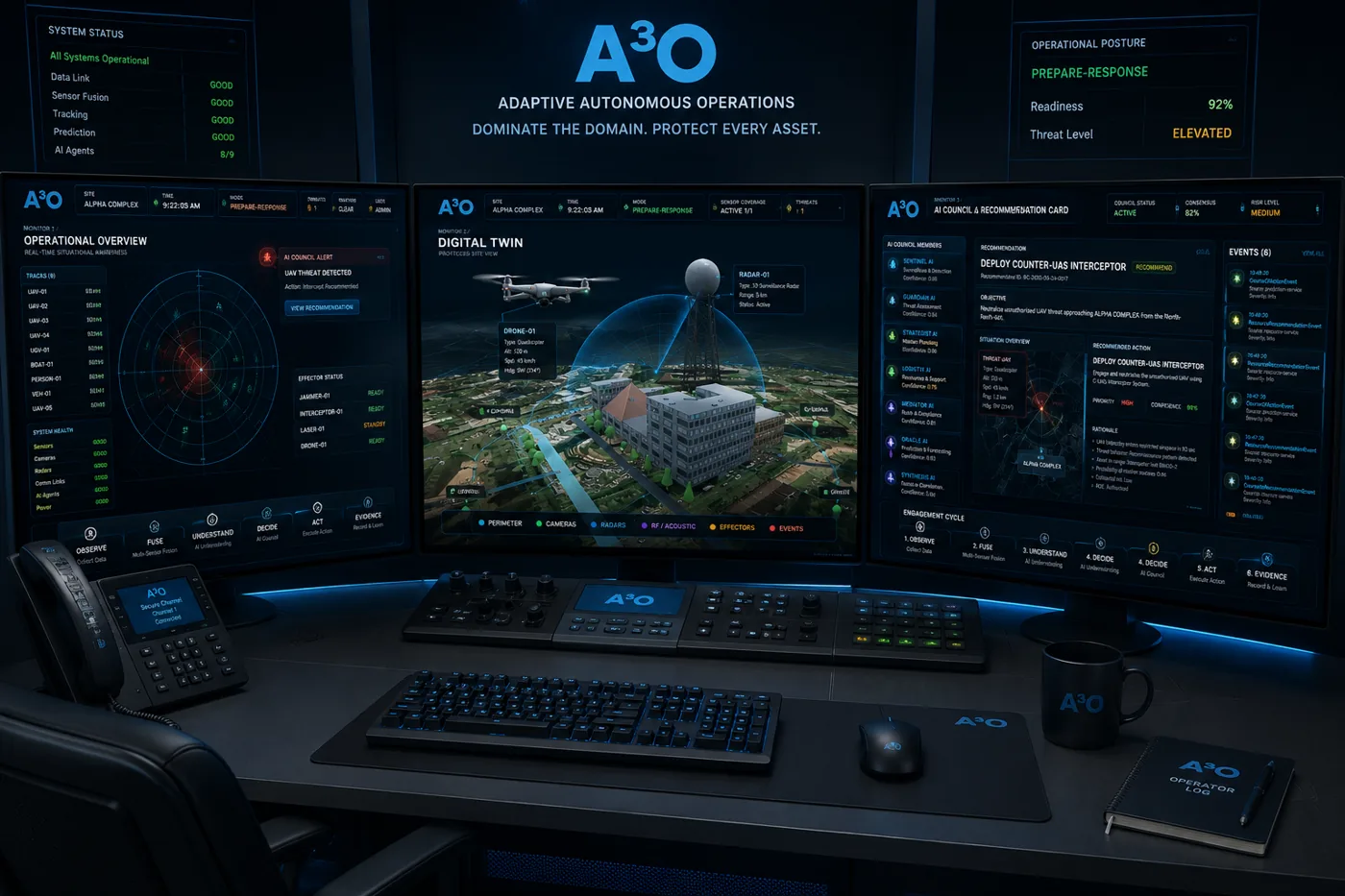
A protected site is not just a map — it contains buildings, roads, fences, restricted zones, sensor coverage areas, cameras, blind spots and high-value assets. A Digital Twin represents this environment so it is understandable to the operator. The Operator Console answers practical questions: what was detected, where it is, which sensors detected it, how confident the system is, the risk level, what to check next and what evidence has been recorded. This is why DroneDefender is designed as a platform, not just a detector — and on the heavy platform the operator does not work alone: an on-board AI Council advises in real time.
AI Council and the operator's copilot
Agents that advise — an operator who decides.
On the heavy A3O platform a multi-agent AI Council works on board — a team of specialised agents that advise while the human decides. A Copilot answers questions about the situation, calls the right modules and proposes a plan, running on a local language model so data never leaves the site. Fusion and Intelligence agents fuse sensor signals into single tracks and score risk with an explanation. A Courses of Action agent proposes response options for a specific target, while Resources and Logistics estimate the probability of success and recommend what to respond with; Weather factors the meteorological picture into the assessment, and a Knowledge agent accumulates lessons from past events and drills so the advice sharpens over time. Every recommendation stays advisory: the AI recommends, the operator reviews, policy and authorization are checked, and critical actions require confirmation — up to mandatory double manual confirmation on critical sites. The platform also looks ahead — AI forecast projects current tracks forward and highlights a 'future' zone on the Digital Twin timeline, linked to recommended courses of action, turning protection from reaction into anticipation.
What a protected site actually needs
Architecture, not a box of devices.
A protected site needs a coherent architecture, not a random collection of devices. Before deployment, the site should be assessed: perimeter, assets, airspace, blind spots, radio environment, lighting, weather, connectivity, operator workflow, evidence requirements and authorized-response policy. The right solution differs for an energy facility, logistics hub, port, temporary event, corporate campus or critical-infrastructure object. Smaller or temporary sites may start with a rapid-deployment package; complex or high-risk sites may need a full edge platform with local AI analytics, Digital Twin and evidence storage.
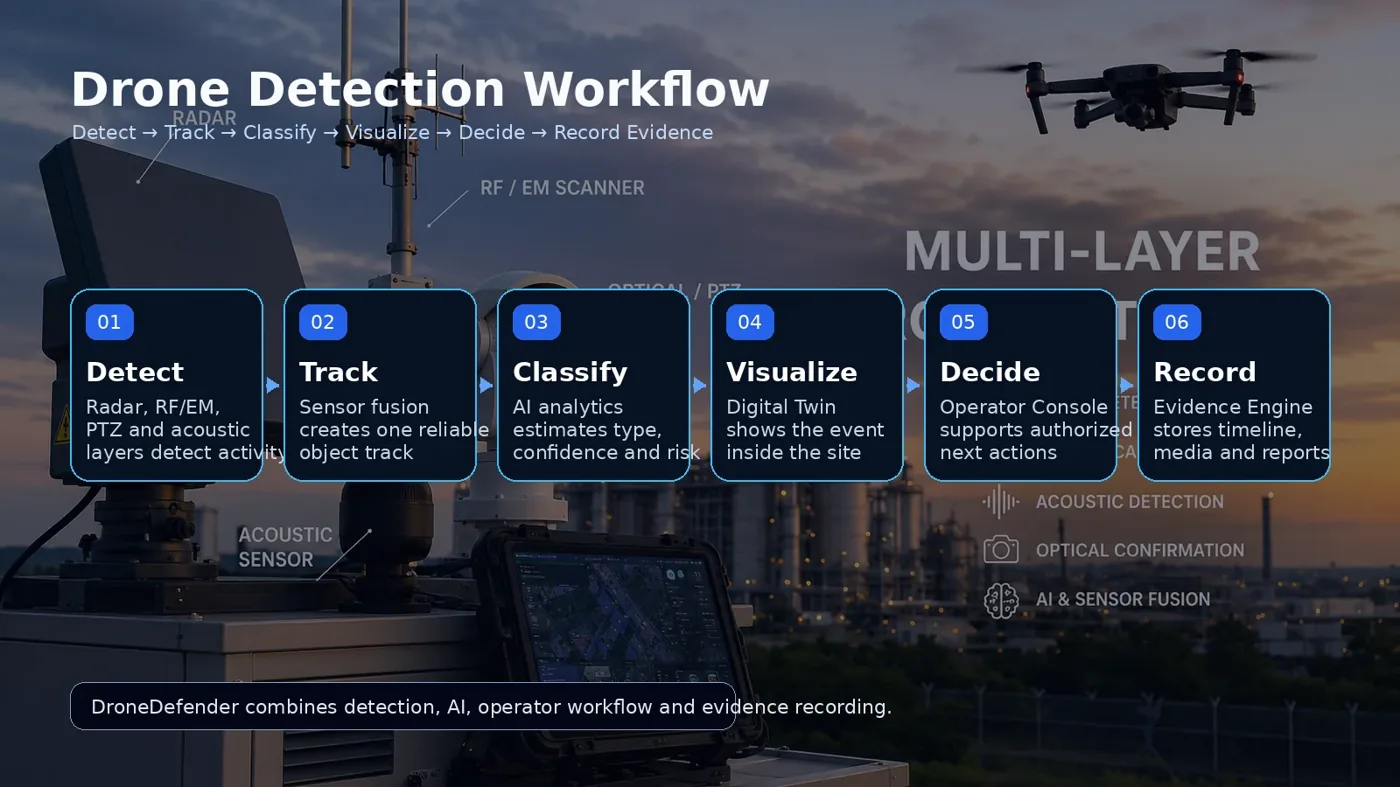
How DroneDefender approaches multi-layer detection
From isolated detectors to one platform.
DroneDefender connects detection systems, AI analytics, Digital Twin, Operator Console and authorized-response workflows into one operational picture of the protected site. The platform integrates radar detection, RF/EM scanning, optical PTZ tracking, thermal confirmation, acoustic detection, AI analytics, an on-board AI Council and Copilot, Digital Twin visualization, operator decision support and evidence recording. The deployment model adapts to the site: DroneDefender Online for lighter deployments, A3O Mini for rapid local deployment, a full edge platform for high-risk or offline-capable sites, a custom object complex for larger areas, a Pilot Program for validation and a Rental package for temporary protection.
Frequently asked questions
What is multi-layer drone detection?
Multi-layer drone detection is a counter-UAS approach that combines radar, RF/EM scanning, optical PTZ cameras and acoustic sensors into one fused operational picture of a protected site.
Why is one drone detection sensor not enough?
One sensor cannot perform equally well in all environments. Radar, RF, optical and acoustic detection each have strengths and limitations. Combining them improves situational awareness and reduces dependence on a single technology.
What is radar drone detection?
Radar drone detection uses radar to detect and track moving aerial objects. It is useful for wide-area monitoring and can help detect drones that are not transmitting radio signals.
What is RF drone detection?
RF drone detection monitors radio-frequency activity associated with drone control links, telemetry, video transmission, Remote ID or other wireless signatures.
Can acoustic sensors detect drones?
Yes. Acoustic sensors support drone detection by listening for drone sound signatures. They are most useful as a passive near-field layer and should be combined with other sensors.
Why is optical PTZ confirmation important?
Optical PTZ confirmation lets the operator visually verify the detected target, support classification and record evidence.
What is sensor fusion in counter-UAS?
Sensor fusion combines data from different sensors into one track or event. Instead of separate alarms, the operator receives a unified view with location, confidence, risk level and supporting evidence.
Can DroneDefender work without internet?
DroneDefender can be configured for local edge deployments where core detection, visualization and operator workflows continue with limited or no internet access, depending on configuration.
Does the AI decide whether to respond?
No. The AI Council and Copilot advise — they fuse sensors, score risk, propose courses of action and recommend responses — but the operator decides. Policy and authorization are always checked, and critical actions require human confirmation.
Does the AI copilot send data to the cloud?
On the heavy A3O platform the Copilot runs on a local language model, so situational data stays on site. The platform can keep detecting, advising and recording locally even without internet access.
Need to evaluate drone detection coverage for your site?
Start with a consultation, demo or pilot.
Drone detection is not a one-device problem. A protected site needs a layered architecture that can detect, track, classify, visualize and record drone-related events — radar, RF/EM, optical PTZ and acoustic each solve part of it, sensor fusion connects the parts, the Digital Twin gives context and evidence recording documents the incident. Start with a short consultation, live demo or structured pilot: DroneDefender can assess your site, identify blind spots and define the right sensor mix for your environment.
Ready to discuss your site?
Start with a short consultation, live demo or structured pilot program.