DroneDefender / A³O

Site UAV Vulnerability Audit

An on-site assessment run to a formal protocol: nine phases, thirteen threat classes, measured values instead of opinions. You get a prioritised, costed plan that works as a procurement specification.

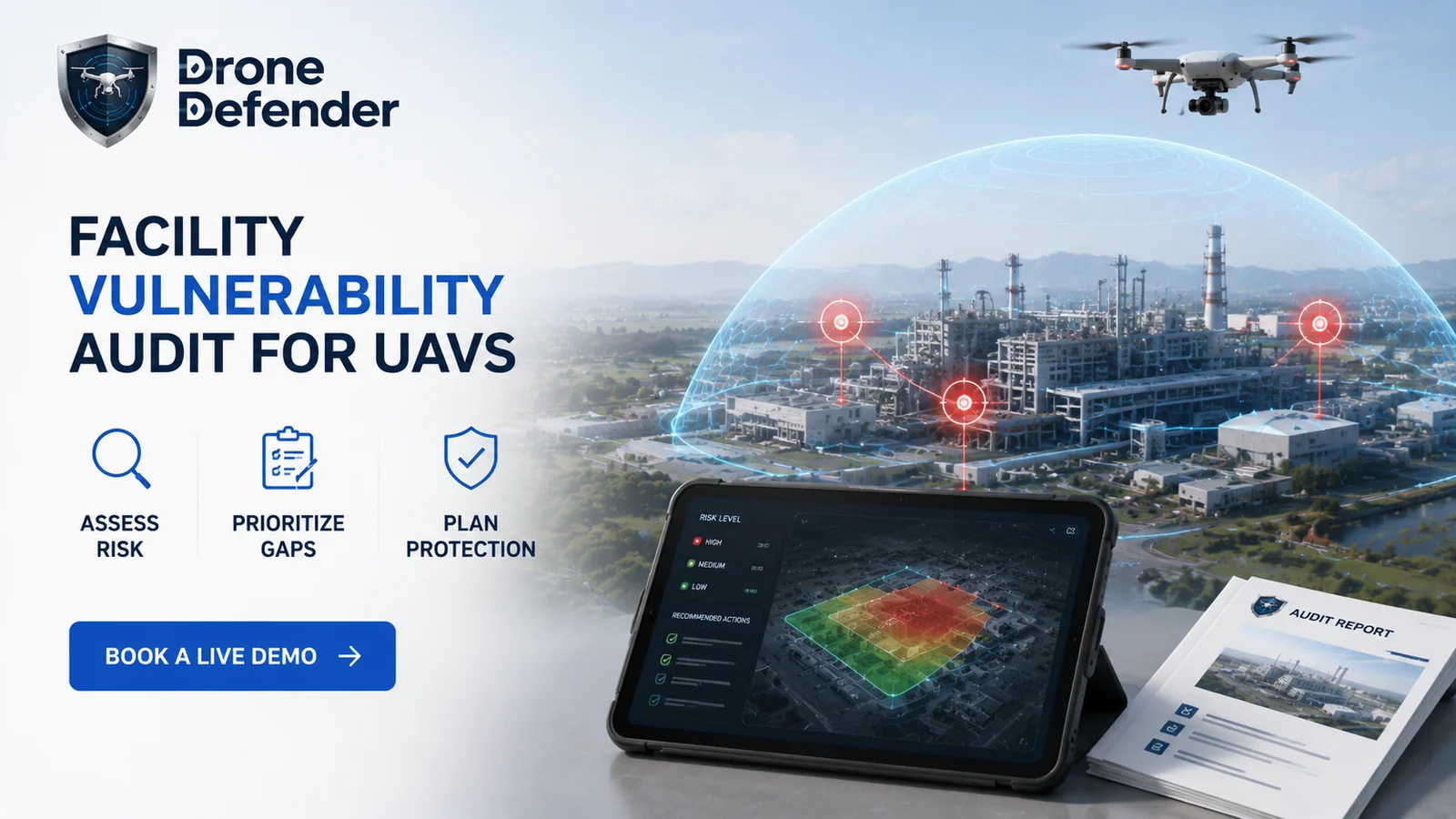
DroneDefender facility vulnerability audit for UAVs

Why an audit comes first

Measure first, buy second.

The most expensive way to learn about a blind spot is to learn about it during an incident. An audit looks at your site through the eyes of a hostile operator: where he comes in from, what he can achieve, how much time your shift has and what they are actually permitted to do. The result is not a consultant's opinion but measured values you can defend in front of a board and present to a regulator.

✓ An audit is not an equipment demonstration. It answers the question of what your particular site needs — regardless of whose equipment you buy afterwards.
✓ «The existing cameras and procedures are sufficient, one sensor in the blind corner is all you need» is a common and entirely legitimate finding.
✓ For entities identified as critical under Directive (EU) 2022/2557, a risk assessment covering hybrid threats is mandatory: nine months from identification, with 17 April 2027 as the outer deadline.

What exactly gets checked

Six areas, none of them skipped.

The priority of the areas changes with the type of site, but their composition does not. If there is nothing to report in an area, the report says so explicitly: checked, no significant findings.

✓ Approach corridors and airspace: where an aircraft can come from, at what altitude, using which terrain and cover. This is also where probable launch points are identified — the operator has to stand somewhere.
✓ Assets and consequences: what cannot be stopped at this site and what it costs if it is hit. Protection effort follows consequence, not the length of the fence.
✓ RF and GNSS environment: measured, not assumed. Noise floor, interference generated by the site itself, navigation resilience against jamming and spoofing.
✓ Existing sensors and the seams between them: what cameras and radars actually see against a small, low-flying target — usually considerably less than the datasheet range.
✓ Response time end to end: from the first detection to the moment a person with authority is ready to make a decision. This is the key figure of the whole audit.
✓ Legal and organisational authority: what is permitted at this site in this jurisdiction, who is authorised to act, and how long they take to arrive.

What we test against

A site is not checked «in general» but against a closed list of thirteen threat classes. The list is reviewed at least twice a year.

Threat groupWhat it coversWhat answers it
Control links you cannot seeFibre optic, cellular-network control, autonomous flight in radio silence, satellite linkThe RF line is empty against these. Acoustics, radar and optics do the work
Conventional radio controlOff-the-shelf aircraft on known bands, including Remote IDPassive RF line, 5–10 km — the earliest warning available
Conditions that make observation hardSmall radar cross-section, night, fog, rain, swarm employmentRadar and acoustics, optics with a thermal channel, rehearsed procedures
Physical effectPayload release, contact strike, throw-over across the perimeterClose-in detection layer plus procedures for sheltering staff and stopping processes
Surveillance and preparationReconnaissance of site routine, filming of processes, repeat overflightsEvent logging and correlation with previous overflights
Friendly and legitimate trafficContractor drones, the insider, navigation spoofing of your own aircraftRegister of authorised flights, clearance procedure, monitoring of the navigation picture
Attack on the protection itselfJamming, power cuts, damage to nodes, interference with communication linksNode autonomy, backup links, physical protection of masts and cabinets

How the audit runs

Nine phases in strict order. A phase can be skipped only with written consent, and the omission is recorded in the report.

PhaseWhat happensIndicative
0. NDA and preparationWork begins with signing a non-disclosure agreement — before that we request no information about the site at all. Then: client questionnaire, open geospatial data, airspace picture and flight restrictions. The team arrives on site with working hypotheses about approach corridors, not with an empty notebook.1–2 days, remote
1. Kick-off meetingSigning the data protocol with the storage option chosen, clearances, confirmation of the critical asset list with senior management, agreement on the response test.2–3 hours
2. Survey and digital twinPhotogrammetry of the site, or a model assembled from open data. Buildings and their heights, terrain, fence lines, vegetation and the positions of existing cameras go into the model.0.5–1 day
3. Field measurementsSpectrum and GNSS, acoustic background at candidate node positions, sensor inventory, test flights of an agreed aircraft, verification of corridors on the ground.1–2 days
4. Analysis on the twinCalculation of actual coverage volumes, blind-spot map, run-through of approach profiles for every applicable threat scenario.1–2 days
5. People and procedures checkA «cold start» exercise: the time from a target appearing to a person with authority being ready to decide is measured.3–4 hours
6. Legal reviewWhat is lawful at this site, who is authorised to apply countermeasures, the escalation procedure and the evidentiary requirements.0.5 day
7. ReportAssembly of the five-document package and an oral defence of the findings. A report nobody has walked through out loud stays unread.2–3 days
8. Handover and data modeExecution of the chosen storage option (A1, A2, A3 or B), handover of the encryption key to the client, signed record, scheduling of the planned review in 12 months.0.5 day

What gets measured rather than eyeballed

The audit counts as complete when every line has either a measured value or a justified «not applicable».

IndicatorHow it is obtainedWhen it is a problem
Time to decisionStopwatch exercise: from target appearance to a person with authority being readyOver three minutes, or never measured at all
Share of threats coveredThreat-versus-layer matrix against the actual state of the siteFewer than ten of the thirteen classes covered
Layers independent of the radio linkAt least one line that works when the target is radio-silentNo such layer exists — a critical finding
Approach corridor coverageCalculation on the digital twin for altitudes up to 50 mUnder 80 % of identified corridors covered
ObservabilityWho actually looks at the screen, and whenThe alarm arrives where nobody is at that hour
Evidentiary trailCompleteness of the logs after a test eventNo tracks, no video or no timestamps
Node autonomyOperation without external power and communicationsUnder four hours

The digital twin of your site

Coverage and blind spots as a calculation, not as an estimate drawn over a satellite image.

The traditional output of an audit is a document. Documents describe blind spots, but you cannot fly through a document. A spatial model of the site changes what an audit is able to show at all: you can see where each sensor's field of view ends, where two fields fail to meet, and what a low approach along the treeline looks like from every camera already installed — before anyone is asked to approve a purchase. The model is deployed in the A3O Mini Rapid environment. Coverage and blind-spot maps included in the report are calculated from it. Attack simulation on the model and the operator training mode with adversarial AI are available to pilot-programme participants and run on the A3O Mini system deployed at the site.

✓ Buildings and their heights, terrain, fence lines, vegetation — everything that actually determines whether a sensor sees a target or not.
✓ Positions of existing cameras and sensors with their real mounting angles and heights, not the ones on the drawing.
✓ Calculated coverage volumes and a map of the seams between them, tied to approach corridors and to the assets behind them.
✓ The repeat assessment a year later runs on the finished model: what changed is recalculated, the site is not surveyed from scratch.

How this works technically

The team arrives with its own self-contained kit and does not connect to your network.

Capture, processing and storage all run on autonomous equipment we bring with us: a laptop with full-disk encryption, a hardware key, an isolated field switch with no internet access, and media in a sealed case. At no stage is there any connection to your corporate network, Wi-Fi or cloud services. Site material exists only inside that kit until you decide what happens to it next.

✓ Red contour — raw frames and the point cloud. Never leaves the kit, accessible only to the team, deleted by default 30 days after the report is accepted.
✓ Yellow contour — the spatial model and coverage calculations. Encrypted with a key you hold; without your participation the file opens for nobody, including us.
✓ Green contour — the report, maps and roadmap. This is what you receive and can share freely with your own contractors.
✓ Full radio silence: every measurement is passive, none of our instruments transmits. Jamming, spoofing and active probing are not used during an audit.
✓ After the team leaves, nothing of ours remains on site — no equipment, no accounts, no temporary access. Only signed records.

Four options for handling the data

A spatial model of a site is, in effect, a detailed map of its vulnerabilities. The option is chosen before work starts and fixed in a protocol signed together with the contract. In every option where the model is retained, the encryption key belongs to you: we physically cannot open the file without your participation.

A1

A1 — on a dedicated server in the EU

The model sits encrypted on our server in an EU jurisdiction. The encryption is enveloped: the file is closed with a session key, and that session key is closed with yours. We hold the container, you hold the key; without it the contents cannot be read even with full access to the disk. Every access is logged, and after 12 months the model is updated on schedule without a repeat survey.

Learn more →
A2

A2 — on your premises

The encrypted container stays with you: on your server, inside your perimeter, under your backup rules. Neither a copy nor a key remains with us. For the scheduled update a year later you grant us access to the container for the duration of the work — and revoke it immediately afterwards.

Learn more →
A3

A3 — offline, in a safe

The model is written to two encrypted drives and handed over to you against a signed record; there is no network storage at all. This is the option for sites where any presence of data on a network counts as unacceptable risk. The update a year later runs on the drive you issue to the team for the duration of the work.

Learn more →
B

B — we keep nothing

All material is destroyed within 10 working days of the report being accepted, backups included, with a signed certificate. You keep the report, the maps and the calculations; we keep only the fact that the work was performed. A repeat assessment will require the full cycle of work, including a new survey.

Learn more →

What you receive

Five documents — enough to approve or reject a budget without further study.

Site

Site threat profile

Scenarios realistic for your site with likelihood and consequence ratings, and a findings register with risk scores.

Learn more →
Coverage

Coverage and blind-spot map

What the existing sensors actually see, where the seams run and which of them open onto approach corridors.

Learn more →
Recommended

Recommended detection scheme

Positions and rationale, calculated from assets and consequences rather than from the length of the perimeter.

Learn more →
Response

Response and legal matrix

What is lawful at your site, who is authorised, what the escalation procedure is and what to record so an incident can be handed to law enforcement.

Learn more →
Costed

Costed roadmap

A phased plan in which the first phase has standalone value and can be implemented without the rest.

Learn more →

Timeline and organisation of the work

A site of medium complexity: perimeter up to 4 km, up to 40 existing cameras, one duty shift.

The full cycle takes seven to eleven working days, of which the team spends two to three on site. A major airport or an extended linear asset is scoped separately. Sites of the same type are usually assessed on a representative sample, with the conclusions then extended to the rest.

✓ A team of three to five: audit lead, RF environment engineer, sensor engineer, digital-twin specialist, procedures and legal analyst.
✓ All measurements are passive. Active RF emission is not used during an audit unless agreed otherwise in writing.
✓ Flights are conducted only to an agreed plan, with permissions and notification of the duty shift.
✓ The response test is run after the responsible managers have been notified: the goal is to measure the procedure, not to stage a surprise alarm.

Frequently asked questions

How is an audit different from a counter-UAS demonstration?

A demonstration shows what a product can do under conditions the vendor selected. An audit establishes what your site needs, independently of any product, and produces the specification the product then has to meet. That order is precisely what protects you from buying a sensor that will not see the approach that actually matters.

Will we have to buy something as a result?

No — and an audit that assumes otherwise is a bad audit. A frequent and entirely legitimate outcome is that the existing cameras and procedures cover more than expected, and the correct next step turns out to be narrow: one sensor in the blind corner, or a change to the list of people who get called at night.

How long does an audit take?

The full cycle is seven to eleven working days for a site of medium complexity, of which two to three are field work. Spectrum capture and coverage modelling run in parallel; the report and roadmap are prepared afterwards.

What happens to our site data after the audit?

You decide that before work starts, and there are four options. The model can be stored encrypted on our server in the EU, on your own premises, offline on drives in your safe — or not stored at all: all material is destroyed within ten working days of the report being accepted, with a signed certificate. In all three storage options the encryption key belongs to you, so we are technically unable to open the model without your participation. Your site material is never passed to third parties under any circumstances and is not used to train models without separate written consent.

How often should the assessment be repeated?

The Critical Entities Resilience Directive requires a review at least every four years — that is the floor, not the target. In practice the trigger is a change in the picture: a new class of approach spreads, a building goes up nearby, a process is relocated, the duty roster changes. If the model of the site has been retained, the repeat check runs on it and costs substantially less than the first audit.

Do you only check the RF channel?

No, and that is fundamental. Four of the thirteen threat classes — fibre optic, cellular-network control, autonomous flight in radio silence and the satellite link — are not detected by an RF line at all. If a site has no layer that works when the target is completely silent, that is recorded as a critical finding regardless of how much money has gone into RF equipment.

Does production have to stop during the work?

No. Measurements are taken with the plant running as usual — indeed, some of them only make sense that way: the acoustic background is measured both during a working shift and in quiet conditions, because the real range of the acoustic layer depends on it.

Can protection be deployed straight after the audit?

The roadmap is built so that the first phase has standalone value and can be implemented without the rest. Many clients start with a pilot deployment at the most problematic sector — which also lets them verify the audit's calculations in practice.

Start with an audit, not with a purchase

Find the gap before someone finds it for you.

An audit turns «we need counter-drone protection» into a plan with numbers, and becomes the document that justifies everything that follows — both to your own management and to the regulator. Describe your site in the form below and we will come back with a work plan and timeline.

Or write to us directly: audit@dronedefender.eu

Ready to discuss your site?

Start with a short consultation, live demo or structured pilot program.